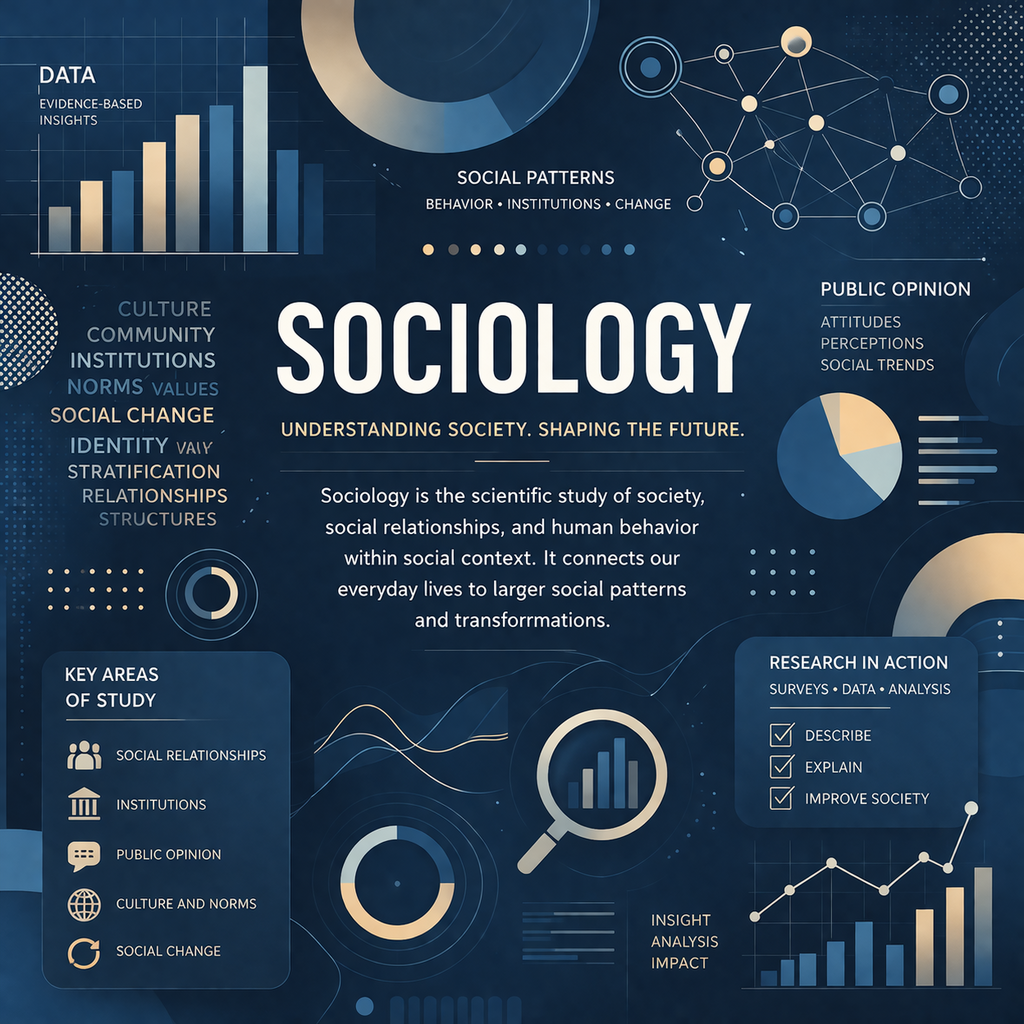
Sociology explores how people live together, interact, and shape the society around them. Rather than focusing only on individuals, it looks at patterns - the ways in which our choices, opportunities, and behaviors are influenced by larger social structures.
For example, when young people in Armenia choose to migrate abroad for work or education, this is not only a personal decision. It is also connected to economic conditions, labor market opportunities, educational systems, and broader social expectations. Sociology helps us understand these connections and see how individual experiences reflect wider social processes.
Another important area of sociology is the study of institutions such as family, education, and government. In Armenia, changes in the education system, discussions around curriculum reforms, or the role of universities in shaping future professionals are all topics that sociologists analyze. Similarly, the transformation of family structures - for instance, differences between urban and rural lifestyles or changing roles within households - provides important insights into how society evolves.
Sociology also pays close attention to public opinion on social and political issues. Surveys conducted in Armenia often reveal how people perceive governance, media, or economic conditions. These opinions are not formed in isolation; they are shaped by information sources, social environment, and collective experiences. Understanding public opinion allows researchers and policymakers to better respond to societal needs.
Culture and social norms are another key focus. Everyday behaviors - from how people communicate online to how traditions are maintained or transformed - reflect deeper cultural patterns. For instance, the increasing role of social media platforms among Armenian youth is not just a technological trend, but also a social phenomenon that influences communication, identity, and access to information.
Finally, sociology studies social change - how societies transform over time. Armenia has experienced significant social, political, and economic changes in recent decades. These transformations affect how institutions function, how people relate to each other, and how the future is imagined. Sociology provides the tools to analyze these changes systematically and understand their long-term implications.
In this way, sociology connects everyday life with broader social dynamics, helping us see patterns that are not immediately visible but deeply shape our reality.